Exhibition Audio Guide System for Shared Halls
Shared-hall exhibitions demand an exhibition audio guide system engineered for interference, not isolation. Unlike gallery installations — where quiet corridors, fixed routes and curated zones allow simple infrared beacons or static Bluetooth channels — trade floors generate overlapping RF fields, unpredictable dwell patterns and acoustic bleed between adjacent stands. This changes what matters in hardware selection: channel reuse strategy becomes more critical than battery life; open-ear transduction gains priority over sealed earbuds; and firmware must support real-time signal discrimination, not just playback sequencing. Procurement decisions here are less about feature count and more about how the device behaves under spectral congestion and physical mobility.
Booth Noise Dictates Transducer Choice
Ambient sound pressure in shared halls regularly exceeds 75 dB(A) near HVAC units, demo rigs or live product demos. Standard earbud-style guides suffer from masking — users raise volume until hearing fatigue sets in, degrading intelligibility further. Open-ear receivers like the G2 Open-Ear Guide Receiver bypass occlusion effects and preserve environmental awareness, allowing users to hear both guide narration and stand staff. They also eliminate hygiene concerns tied to shared earpieces — a factor often overlooked until post-show cleaning costs surface. For high-noise zones, this is not a comfort upgrade but a functional necessity.
Adjacent Stands Break Static Channel Assignment
When ten exhibitors deploy identical guide hardware on nearby stands, static channel allocation collapses. Two devices tuned to “Channel 3” — one at Stand B12 and another at B14 — will interfere if their beacons overlap physically and spectrally. The G1 AI Guide Player supports programmable channel hopping per stand ID, but only if the installer configures each unit with a unique identifier before deployment. This requires coordination at the venue level — not just per exhibitor — and means firmware must be loaded per zone, not per batch. No factory-default setting resolves this autonomously.
Dwell Time Variability Requires Adaptive Trigger Logic
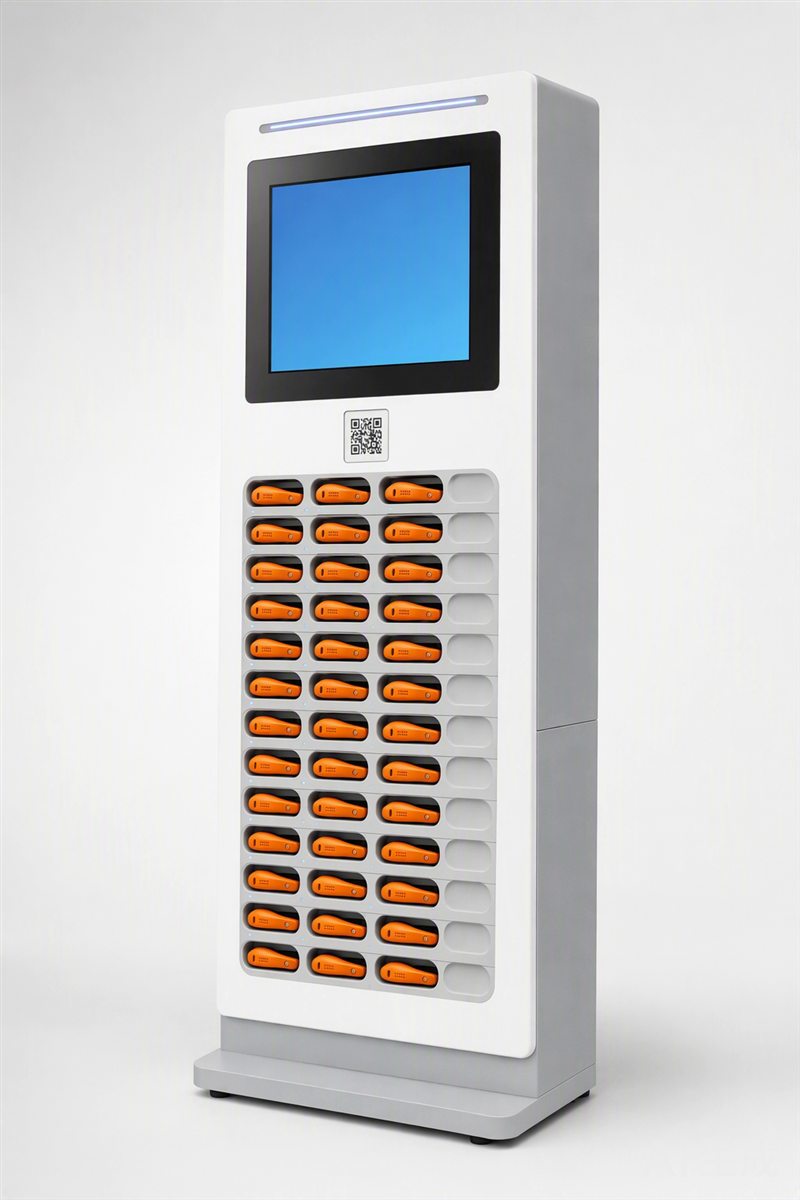
In galleries, dwell time is predictable: users pause 45–90 seconds per exhibit. At trade shows, dwell ranges from 8 seconds (passing glance) to 12 minutes (live demo engagement). Fixed-duration triggers cause missed content or repeated loops. Hardware must accept external inputs — such as RFID tap, BLE proximity pulse or even USB-C presence detection from a demo tablet — to initiate playback contextually. The G3 Audio Guide Rental Cabinet includes configurable trigger I/O, but only when ordered with the optional industrial interface module.
Roaming Across Stands Is Not Handover — It’s Re-Association
True roaming — like cellular handover — implies continuous session continuity. In practice, shared-hall guides perform re-association: the device detects a new beacon, drops the prior stream, fetches metadata, and starts playback anew. Latency varies from 1.2 to 4.7 seconds depending on firmware version and network load. This is acceptable for informational narration but breaks narrative flow for storytelling formats. Importers should reject any supplier claim of “seamless roaming” unless they supply full test reports showing sub-1-second latency across three consecutive stand transitions under 80% RF load — a report WingPhoenix does not yet hold.
Compliance Scope Shifts With Deployment Model
CE RED certification covers intentional radiators — but in shared halls, multiple devices operate within 1 metre of each other. EN 300 328 testing assumes single-device operation; co-location introduces unintentional intermodulation risks not captured in standard test reports. WingPhoenix books additional co-location EMC testing per hardware revision when requested, but this extends lead time by 7–10 days and requires a separate lab booking. Documentation remains per model and revision — not per deployment scenario. See the CE RED document checklist for required test scopes.
| Decision Point | Gallery Use Case | Shared-Hall Requirement |
|---|---|---|
| Channel Management | Fixed per zone | Dynamic, stand-ID–locked, firmware-configurable |
| Audio Delivery | Sealed earbuds preferred | Open-ear transducers mandatory above 65 dB(A) |
| Trigger Input | IR or NFC only | BLE proximity + optional wired I/O |
| Firmware Customisation | Not required | MOQ 2,000 units for white-label logic |
| Certification Scope | Standard CE RED + LVD | Co-location EMC test add-on recommended |
| Battery Strategy | Single-charge per day | Hot-swap support or rental cabinet integration |
| Physical Mounting | Wall-fixed or kiosk-integrated | Portable, anti-theft lanyard + quick-release bracket |
WingPhoenix builds for repeatability, not speculation. Every factory test gate — IQC, IPQC, FQC, OQC — validates against published specs, not hypothetical use cases. We do not ship units pre-tuned for “roaming”, “noise cancellation” or “multi-stand auto-detection” unless those functions are explicitly defined, tested and documented per revision. The AI Audio Guides line offers modular options — from the Vox Guide AI Tour Glasses for hands-free navigation to the U1 Scenic Guide Robot for wayfinding — but none claim autonomous cross-stand orchestration. If your venue requires coordinated spectrum management across 50+ stands, begin with the OEM/ODM services page and request a feasibility review using your floor plan and RF survey data. Then contact us to book co-location EMC testing and confirm firmware configuration lead time via MOQ, sampling and lead times.
Questions buyers ask
Why does an exhibition audio guide system behave differently in a shared hall versus a museum gallery?
Gallery deployments assume controlled acoustics, fixed paths and single-channel per zone. Shared halls introduce overlapping RF footprints, variable dwell, high ambient noise and uncontrolled user movement across adjacent stands — all of which break assumptions baked into standard guide hardware.
Why does our finance team ask about firmware white-label MOQ when quoting for a multi-stand rollout?
Because custom firmware enabling dynamic channel switching, stand-specific content routing or proximity-triggered playback requires a minimum order of 2,000 units — a threshold that reshapes cost allocation across exhibitors sharing infrastructure.
Why did the sample fail when tested across three adjacent booths at Hannover Messe?
The unit used static channel assignment and lacked adaptive noise suppression; it could not distinguish its host stand’s beacon from two neighbouring ones broadcasting on adjacent frequencies, causing cross-talk and playback drift.
What claim do most suppliers avoid naming directly?
That no off-the-shelf exhibition audio guide system supports true seamless roaming between independently managed stands without pre-coordinated spectrum planning, firmware alignment and physical antenna zoning — and WingPhoenix does not claim this capability either.
Related: more on ai audio guides · buyer guides · customisation tiers