Smart Ring Sizing: Kits, Exchange Rates and the First Stock Split
Ring sizing is the first place a smart ring programme fails, and it fails before production, not after. A buyer who orders 1,000 units in a flat size curve will lose margin to exchanges, and a buyer who adds a sizing kit without deciding where it sits in the box will lose margin to logistics instead. The decision is not a product feature; it is a returns and working-capital decision that you make at the quotation stage. This article sets out how the kit-in-box choice moves your exchange rate, and how a first order should split sizes across a range.
What the sizing kit actually changes
A sizing kit is a set of plastic gauges that lets a customer find a size before the ring ships. Where you place it changes three things: the number of parcels per order, the return rate on the ring itself, and the exchange rate you carry in your margin model. If the kit ships separately, the customer receives two parcels and may return the ring because the size was wrong. If the kit ships inside the retail box, the customer tries the gauges, keeps the ring, and returns only the kit if anything. The second model usually produces a lower exchange rate, because the returned item is low-value and light. The trade-off is that you pay for the kit in every box, including the boxes where the customer never uses it.
There is no universal answer. Distributors in Germany and the Netherlands tend to prefer a separate kit SKU because their returns infrastructure is efficient and their customers expect a clean retail box. Brand owners selling direct in the US and Canada often prefer the in-box kit because it removes a step from the unboxing and reduces the chance of a wrong-size return. Decide this before you ask for a quotation, because it changes the bill of materials and the packaging line.
Why the kit decision moves your exchange rate
Exchange rate here means the proportion of shipped units that come back, not a currency rate. It is the number that decides whether a sizing programme is profitable. A ring that is returned has to be received, inspected, cleaned, re-bagged and re-shipped, and in many markets it cannot be sold as new. The cost is not the ring; it is the handling. A kit that costs a fraction of the ring and can be returned in a padded envelope changes the arithmetic entirely.
When you model this, separate the two return paths. The ring return path carries the full handling cost and often a write-down. The kit return path carries a small handling cost and no write-down. If your in-box kit reduces ring returns by even a modest amount, it usually pays for itself, but you should test that assumption against your own market rather than accept it. Ask your supplier for the kit cost as a line item, not as a bundled figure, so you can compare the two models honestly. Our MOQ, sampling and lead times page sets out how kit and ring quantities interact at the quotation stage.
How the first order splits across sizes
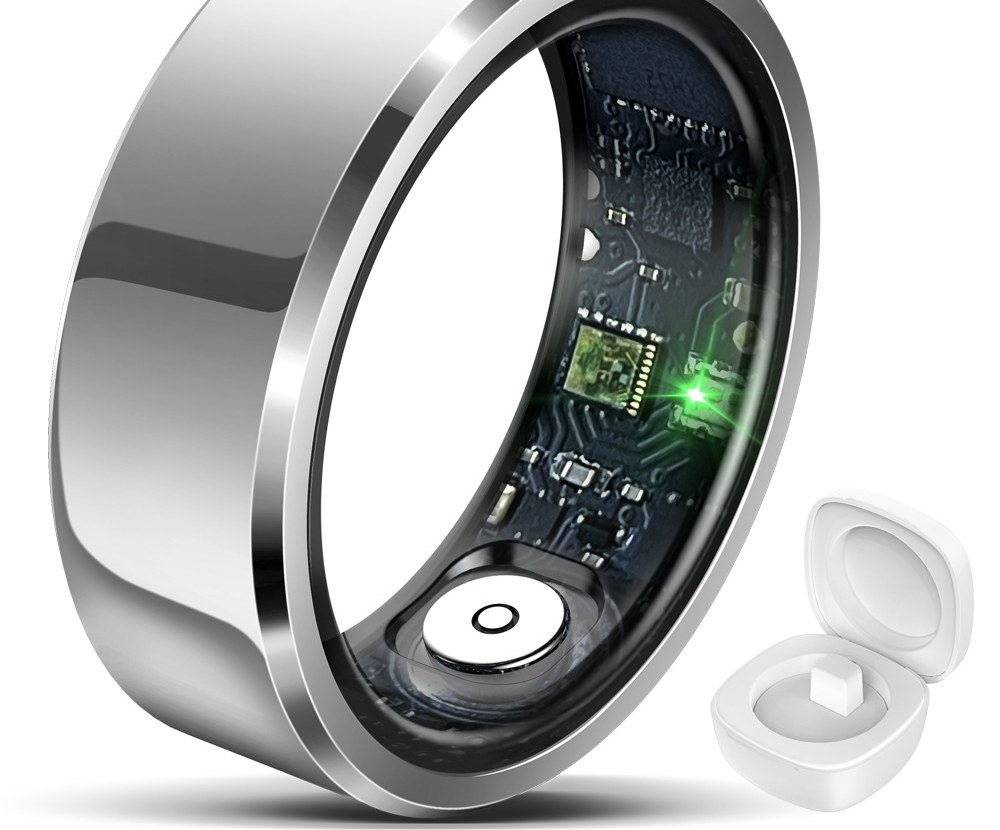
The first order is a forecast, not a fact, and it should be treated as one. Ring models such as the R2 smart ring with charging case and the R1 smart health ring are sold across a size range, and the range is not evenly distributed. Most demand sits in the middle sizes; the extremes are thin and slow. A first order that spreads 1,000 units evenly across eight sizes will leave you with dead stock at both ends and stockouts in the middle.
A more defensible first split concentrates volume in the middle sizes and treats the extremes as special order until you have exchange data. The exact curve depends on your market and your customer, so the honest answer is that you should not guess. Run the kit first, collect the size distribution from real customers, and place the ring order against that data. If you must order before you have data, hold the tail sizes thin and accept a longer lead time on replenishment.
| Decision point | Separate kit SKU | Kit inside retail box |
|---|---|---|
| Parcels per order | Two | One |
| Returned item value | Low (kit only) | Low (kit only) |
| Retail box presentation | Clean, unopened | Opened before ring arrives |
| Kit cost exposure | Only on kit orders | On every unit shipped |
| Best fit | Distributor and retail channels | Direct-to-consumer brands |
| MOQ impact | Kit and ring quoted separately | Kit folded into ring BOM |
Compliance and documents you should confirm early
A skin-contact wearable carries a document set that a buyer should confirm before the purchase order, not after. For the ring family, the relevant scope is CE RED, FCC Part 15, RoHS 3, REACH SVHC screening, battery UN38.3 with SDS, and EN 1811 nickel release for skin-contact items. UKCA is available on request. None of this is a claim that a certificate is already held; it is a test scope booked per hardware revision with an accredited laboratory, and you should ask to see the scope against the revision you are buying. Our CE RED document checklist explains how to read that scope, and the same discipline applies to a ring.
Two further points sit with you as importer. EU and UK importer duties such as WEEE, BattG, DEEE/Triman, and EORI/VAT registration are the importer's responsibility, not the factory's. And health metrics on any ring are wellness guidance, never diagnosis. If your marketing copy blurs that line, you create a compliance problem that no sizing kit will solve.
Where to say no
A supplier who will not quote the kit as a separate line item, who will not state the size range and the size curve assumption, or who treats certification as a document you can sort out later is a supplier you should decline. The supplier vetting guide covers the questions worth asking. If you are planning a private-label programme, the OEM/ODM services page explains how tooling and firmware scope affect the timeline, and the factory page shows how IQC, IPQC, FQC and OQC gates work at AQL 2.5 major and 4.0 minor. Standard MOQ is 500 units; ring models sit at 1,000 units, with firmware or app white-label at 2,000.
- Confirm whether the kit is a separate SKU or part of the retail box before quotation.
- Ask for the kit cost as a line item, not bundled into the ring price.
- Collect real size distribution from the kit before committing to a full size curve.
- Hold tail sizes thin on the first order and plan a replenishment path.
- Confirm the certification scope against your specific hardware revision.
- Confirm importer duties sit with you, not the factory.
The next step is a sizing kit sample and a written quotation that separates kit cost, ring cost and packaging cost, so you can model both return paths against your own market. Send the specification through the contact page and ask for the kit and ring quoted separately, with the size range and the assumed size curve stated in writing.
Questions buyers ask
Should the sizing kit ship inside the retail box or as a separate SKU?
A separate kit SKU keeps the retail box clean and lets you recover kit cost, but it adds a second parcel and a second return path. An in-box kit lowers the exchange rate because the customer rarely returns the ring itself, only the kit, which is cheaper to process.
How should a first order of 1,000 rings split across sizes?
Start from the size curve your kit data produces, not from a guess, and hold the tail sizes thin. A common first split concentrates volume in the middle sizes and treats the extremes as special order until you have exchange data.
Related: more on ai smart rings · buyer guides · customisation tiers