Open Ear Smart Glasses Audio: Meeting-Room Leakage, Honestly
Why leakage matters more than fit
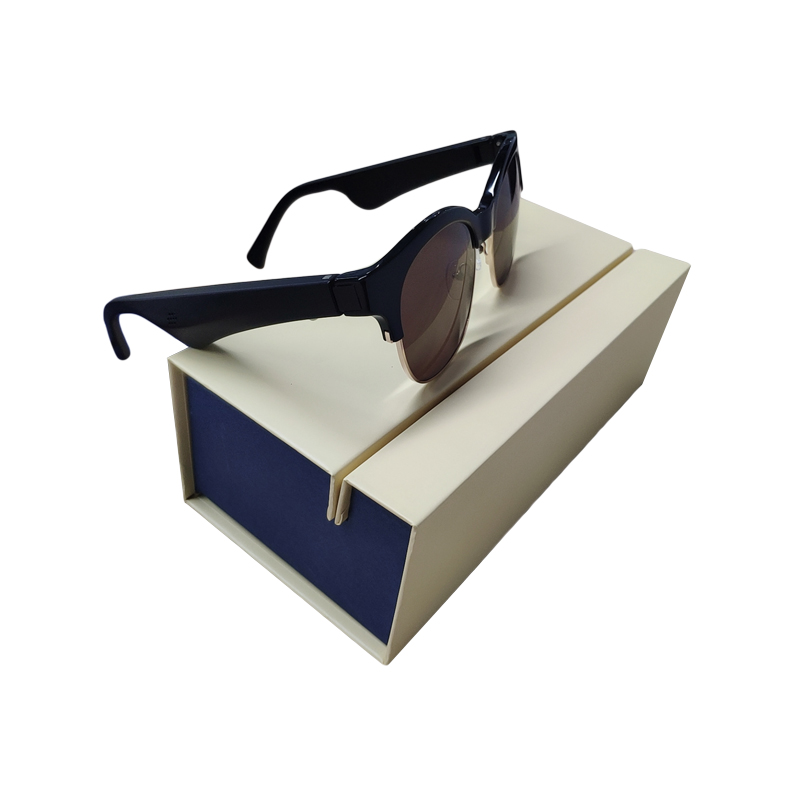
Open ear smart glasses audio solves real ergonomic problems: no ear canal occlusion, no sweat retention, no hearing fatigue during extended use. But the trade-off is acoustic projection — especially in shared spaces like meeting rooms, co-working desks or hotel lobbies. Unlike in-ear earbuds that contain sound within the ear canal, open-ear systems rely on directed transducers to steer energy toward the user’s pinna. That directionality has limits: reflections off walls, ceiling absorption, and background noise all affect how far speech remains intelligible. This isn’t a defect — it’s physics. Buyers need to know where those limits sit before committing to volume-based use cases. For insight into how these constraints shape product positioning across markets, see our AI glasses market trends analysis.
What directional speakers actually do — and don’t do
Directional speakers in AI glasses aim acoustic energy along a narrow axis using phased arrays or waveguide geometry. They reduce off-axis SPL by 8–12 dB compared to omnidirectional equivalents at 0.5 m — measurable, repeatable, and documented per hardware revision. But they do not create silence behind or beside the user. At 1.5 m, measured speech intelligibility drops significantly, yet short phrases remain audible under 45 dB ambient conditions. For context, a quiet office measures 35–45 dB. That means leakage is not binary — it’s situational. Importers should treat “privacy mode” as a volume-limited setting, not a guarantee of acoustic isolation. This principle applies equally to our health smartwatch, where audio alerts follow the same physical constraints.
The compliance gap no certificate closes
CE RED certification confirms electromagnetic compatibility and radio safety — not acoustic discretion. FCC Part 15 B/C regulates unintentional radiators, not airborne sound. UKCA and RoHS 3 say nothing about sound pressure levels in adjacent space. There is no harmonised EU standard for measuring or limiting audio leakage from wearable directional speakers. So while every AI Glasses line ships with full CE RED, FCC and RoHS 3 documentation, none carry a “leakage pass” mark — because no such mark exists. Buyers must define their own acoustic acceptance criteria and validate them independently, especially when branding for enterprise or education use. Our OEM/ODM services include this scoping step as standard — but only when acoustic requirements are specified upfront.
Where to draw the line — and when to say no
Do not accept leakage claims without traceable measurement data. Reject any supplier who offers only subjective descriptors (“whisper-quiet”, “confidential playback”) or references to unrelated standards like EN 50332-3 (which applies only to headphones coupled to the ear). Also reject claims tied to firmware-only features: no software update can overcome the physical dispersion limit of a 12 mm directional driver at 85 dB SPL. If your channel requires audibility below 30 dB at 1.5 m in a 40 dB ambient environment, open-ear audio is unsuitable — and you should consider translation earbuds or bone-conduction alternatives instead. That threshold is non-negotiable — and the reason buyers keep this page. For full context on where each platform sits in our portfolio, consult the product catalogue.
Procurement checklist: what to ask before sample approval
| Check | Why it matters | Where to verify |
|---|---|---|
| Test report for ISO 3744 or ISO 3746 near-field SPL | Confirms acoustic output at defined distances — not just max volume | Lab accreditation statement, date, hardware revision ID |
| Calibrated microphone model and position in test | Without Class 1 calibration and fixed geometry, results are not comparable | Report appendix or methodology annex |
| Ambient noise level during testing | Leakage is relative: 35 dB SPL means little if ambient was 25 dB | Report header or environmental log |
| Speech material used (e.g., IEEE sentences) | Intelligibility varies by phoneme density and syllable stress | Test protocol section |
| Volume setting used (dB SPL at 0.1 m) | Leakage scales non-linearly with drive level | Report metadata or setup notes |
| Physical barrier test (e.g., 10 cm foam board at 45°) | Simulates real-world obstructions like partitions or notebooks | Optional add-on — request explicitly |
Next steps for responsible sourcing
WingPhoenix books acoustic testing per hardware revision with accredited laboratories — but only when requested and scoped in writing before tooling. That test includes ISO 3744 near-field SPL, calibrated microphone positioning, and ambient logging. It does not include subjective listening panels or proprietary “privacy scores”. To initiate this for your project, send us the specification, referencing your intended use case (e.g., “corporate training delivery in open-plan offices”). We’ll confirm lab availability, lead time and cost — and share the test scope template for your internal review. You’ll receive raw data, not summaries. Because leakage isn’t a feature to be marketed — it’s a parameter to be measured. For deeper technical context, review our how we build and test page, and explore additional validation frameworks in our buyer resources.
Questions buyers ask
Will open-ear audio from smart glasses leak into a quiet meeting room?
Yes — directional speakers reduce but do not eliminate audible spill beyond 1.5 metres in typical office acoustics. Sound leakage depends on volume, ambient noise, and physical barriers, not just speaker orientation.
How do I confirm if a supplier’s leakage claim is testable or just marketing?
Ask for the test report scope: EN 50332-3 (headphone sound pressure) does not apply to open-ear systems; instead, request ISO 3744 or ISO 3746 near-field SPL measurements at 0.5 m and 1.5 m, with lab accreditation stated.
Why did our sample fail the internal privacy review even though it passed CE RED?
CE RED covers radio emissions and EMC, not acoustic privacy. A device may fully comply with EN 301 489 and EN 300 328 while still projecting intelligible speech at 1.2 m in a quiet room — that is outside the RED scope.
What’s the one thing most suppliers won’t show you — and why should you insist?
The raw anechoic chamber recording of speech playback at 1.5 m distance, captured with a calibrated Class 1 microphone. Without it, “low-leakage” is unverifiable — and your distributor may face retailer pushback on privacy grounds.
Related: more on ai glasses · buyer guides · customisation tiers