AI Health Monitoring Watch: What the Sensors Actually Sample
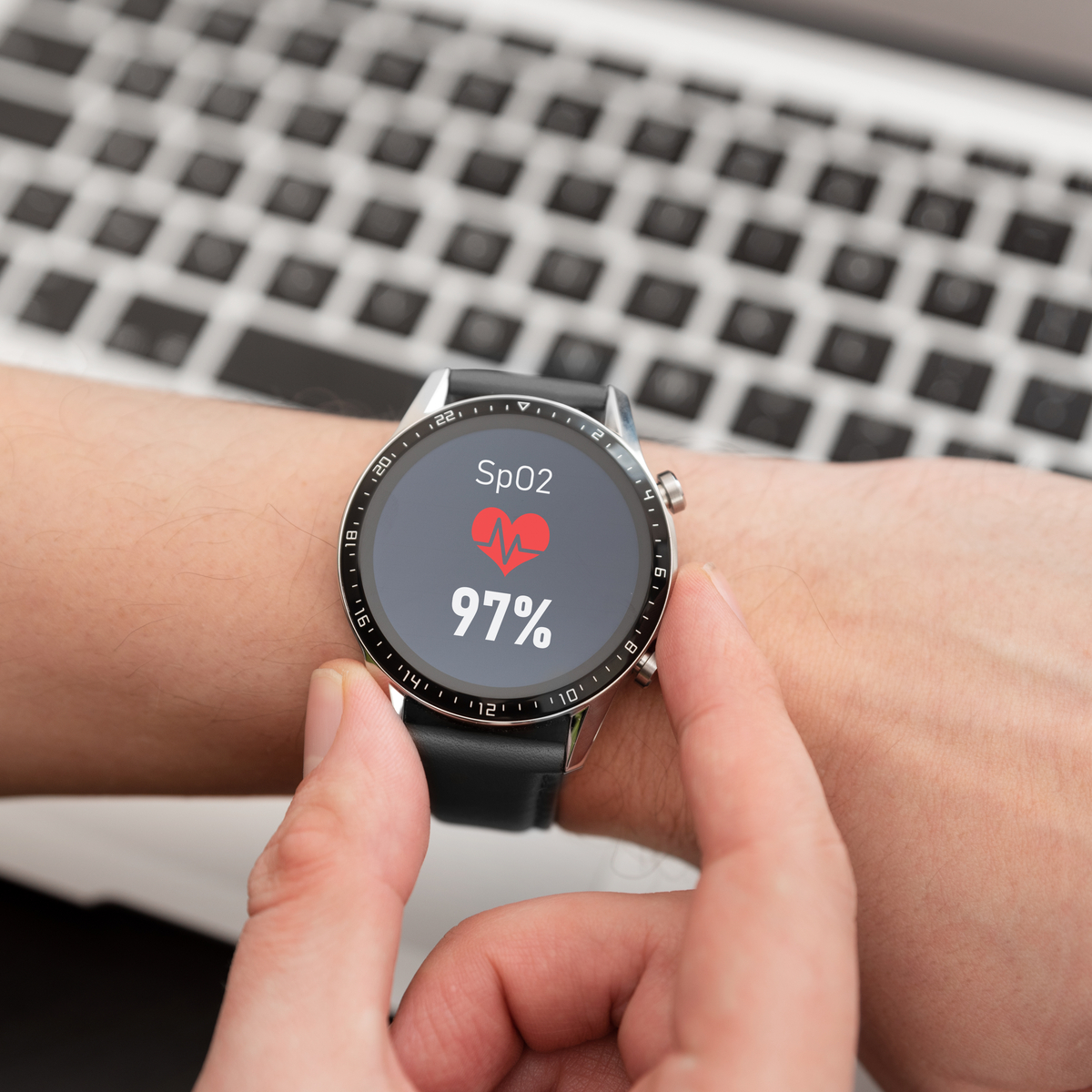
An AI health monitoring watch measures light absorption changes in capillary blood using green and red LEDs, not biochemical markers. Its optical sensor samples reflected light at fixed intervals, generating photoplethysmography (PPG) waveforms that feed wellness algorithms. What it does not measure — glucose, lactate, cortisol, blood pressure or sleep apnoea events — is as critical to procurement decisions as what it does. This article clarifies the physical sampling layer: wavelengths used, timing constraints, motion coupling effects and where signal processing begins and ends.
Green vs Red Light: Purpose, Penetration and Limitations
Green light (typically 520–535 nm) is used for heart rate because it is strongly absorbed by haemoglobin in arterial blood, yielding high-contrast pulsatile signals at the skin surface. Red light (630–660 nm) penetrates deeper and is less affected by superficial motion or skin tone variation, making it more stable for SpO₂ estimation. Neither wavelength detects dissolved oxygen molecules directly — they infer saturation from relative absorption ratios between oxygenated and deoxygenated haemoglobin. The health smartwatch uses both, but its red-channel sampling is decoupled from green in timing and gain control, meaning raw fusion requires post-processing alignment not available in factory firmware.
Sampling Rate: Fixed Intervals, Not Real-Time Streams
Optical sampling occurs at fixed intervals — typically 25 Hz for green, 12.5 Hz for red — but these are hardware-timed, not software-triggered. There is no event-based or adaptive sampling: each LED fires whether motion is present or not, and each photodiode readout is timestamped by internal oscillator, not GPS or network time. Because the system lacks hardware-level timestamp synchronisation across channels, aligning green PPG, red PPG and accelerometer data in post-analysis requires interpolation — a step that introduces phase uncertainty. This matters for buyers specifying algorithm training pipelines: raw data exports from the AI wearables line contain discrete, unsynchronised buffers, not a unified time-series stream.
Wrist Motion: Not Noise to Filter — a Signal to Model
Motion artefact is not removed — it is characterised. The triaxial accelerometer runs continuously at 50 Hz, independent of optical sampling. Its output is not subtracted from PPG; instead, motion magnitude and frequency bands are used as contextual features in the heart-rate variability model. This means motion is not “interference” but an input dimension. However, the firmware does not expose raw accelerometer waveforms alongside PPG in the same export format — they are logged separately, with timestamps resolved to different clock domains. For validation, importers should require aligned binary dumps during lab testing, not processed CSVs.
What This Sensor Cannot See — and Why Claims Stop There
This optical stack cannot detect glucose, blood pressure, hydration status, respiratory rate beyond coarse breath-holding inference, or any analyte requiring spectral analysis beyond two narrow bands. It does not image tissue, track capillary refill, or resolve microvascular flow. No model in the Health & Wellness line supports continuous glucose monitoring claims, nor does any carry a CE Class IIa medical device designation. Importers must reject supplier language implying diagnostic capability — even if embedded in firmware strings or app UI labels — because such claims invalidate the entire CE RED and EN 62368-1 scope. A compliant AI health monitoring watch remains a wellness tool, and its documentation reflects that boundary explicitly.
Data Access: Raw Output, Not Unfiltered Streams
“Raw data” access means factory-calibrated, ADC-converted values — not bitstream-level photodiode voltage or uncorrected LED drive current. Each optical channel includes automatic gain control and ambient light subtraction applied in hardware. The exported PPG is therefore pre-conditioned: baseline drift is suppressed, clipping is flagged, and saturation states are annotated. Buyers requesting true analog-level fidelity must specify custom firmware and validate timing alignment across all sensors — a service available under OEM/ODM services, subject to MOQ and lead-time rules in the MOQ, sampling and lead times guide.
| Parameter | Specification | Procurement Note |
|---|---|---|
| Optical wavelengths | Green (525 ± 5 nm), Red (650 ± 5 nm) | No IR or multi-spectral options in standard builds |
| PPG sampling interval | Green: 40 ms (25 Hz), Red: 80 ms (12.5 Hz) | Fixed hardware timer; no software override |
| Accelerometer rate | 50 Hz, separate clock domain | No hardware sync with optical timestamps |
| Raw data export | Calibrated, AGC-applied, ambient-subtracted | Not analog-level or bitstream |
| Certification scope | CE RED, FCC Part 15, EN 62368-1, RoHS 3 | Tested per hardware revision, not platform |
| Medical claim status | None permitted; wellness guidance only | EN 62368-1 applies, not MDR or FDA 510(k) |
| Battery marking | Wh rating printed on unit + UN38.3 + SDS | Required for air freight compliance |
Importers should require full sensor timing diagrams and clock-domain documentation before approving firmware architecture — especially if planning to retrain or replace onboard models. The how we build and test page details our IQC/IPQC/FQC/OQC gates, and the product catalogue shows which models support firmware white-labeling from 2,000 units. To begin, send us the specification including required optical timing alignment, raw data format, and intended use context — we will confirm feasibility, certification path and timeline before quoting.
Questions buyers ask
What physiological signals does an AI health monitoring watch actually capture through its optical sensor?
It captures photoplethysmography (PPG) waveforms from green and red LED illumination, converted to heart rate, heart-rate variability and movement-corrected blood oxygen saturation estimates — not direct biomarkers.
What does finance need to know about certification timing for a custom AI health monitoring watch?
CE RED, FCC Part 15 and UKCA scopes are booked per hardware revision with an accredited lab; no certificate exists until testing is complete and documented per <a href="https://wingphoenixai.com/resources/ce-red-compliance-smart-watches/">CE RED document checklist</a>.
Why did our sample fail EN 62368-1 thermal testing when the supplier said it passed?
Thermal performance depends on the full build — PCB layout, battery placement and enclosure material — so test scope must match the exact hardware revision shipped, not a prior reference design.
What do most suppliers refuse to disclose about raw sensor output?
That raw PPG data is time-stamped at fixed intervals but not synchronised across LEDs or motion axes — and no model provides unprocessed, timestamp-aligned triaxial accelerometer + dual-wavelength photodiode streams without proprietary firmware filtering.
Related: more on ai health monitoring · buyer guides · customisation tiers